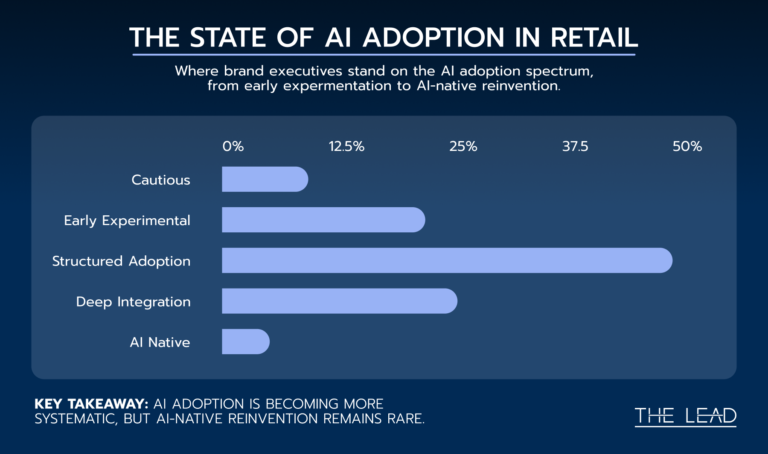
Stage 1: Skeptical or Deliberately Cautious | 9%
Executives in this category remain skeptical of AI’s readiness for high-stakes applications, particularly autonomous transactions and customer-facing experiences. Adoption is limited and focused on evaluating reliability, risk, and potential value.
Stage 2: Early, Bounded Experimentation | 19%
AI use is largely confined to individual productivity tasks, including research, brainstorming, and content creation. Organizations have begun experimenting but have not yet operationalized AI across broader team workflows.
Stage 3: Systematic Adoption with Structure | 45%
Organizations have established frameworks for evaluating AI tools, selecting technology partners, and determining where custom solutions may deliver value. Adoption is increasingly coordinated rather than driven by isolated experimentation.
Stage 4: Deep Integration with Formal Governance | 24%
AI is integrated more deeply into organizational operations, supported by formal governance boards, steering committees, and workforce training or certification programs. Oversight and consistency are central to implementation.
Stage 5: AI-Native Reinvention | 3%
Executives in this category describe approaches that fundamentally reconsider how entire business functions operate. Rather than adding AI to existing workflows, they are exploring how functions could be redesigned around AI capabilities.
Key Finding: Adoption Is Advancing But Reinvention of Business is Remains a Frontier
For most organizations, AI adoption currently focuses on improving existing processes through automation, research, and productivity gains. A smaller group is exploring a different question: If this business function were built from scratch today, how would AI change its design?
As Oscar Diaz, SVP, Technology & Digital Innovation at G-III Apparel Group put it,
“Technology is giving us the opportunity to rethink how fashion gets created, not just make existing processes faster. AI is changing what’s possible across creativity, decision-making, and execution, but the real opportunity is in how we combine that technology with the instinct, taste, and experience that have always driven this industry. The companies that get that balance right will define what comes next.”
Key Finding: Governance and Workforce Readiness Are Becoming Priorities
Adopting AI consistently and responsibly is the key priority for executives on our list. Executives described investments in:
- Formal frameworks for evaluating AI applications and technology partners.
- Governance structures to oversee implementation and manage risk.
- Employee training and certification programs.
- Data quality and infrastructure to support AI applications.
According to Sahal Laher, EVP/CIO, Centric Brands,
“The bigger risk right now isn’t moving too fast, it’s staying on the sidelines. The companies that wait to see how this plays out are going to get leapfrogged by the ones willing to test, learn, and scale. That said, speed without guardrails is just as dangerous, so we’ve built a measured, crawl-walk-run approach rather than rushing everything at once.“
Implications for Retail and Consumer Brands
The findings point to three considerations for organizations evaluating their AI strategies.
- Move beyond adoption as a measure of progress: The number of AI tools deployed does not necessarily reflect the value they create. Organizations should assess whether AI is meaningfully improving outcomes rather than simply increasing usage.
- Invest in the organizational foundations: Data readiness, governance, workforce capabilities, and clear evaluation frameworks can determine whether AI applications deliver sustainable value.
- Identify where reinvention makes sense: Not every workflow needs to be rebuilt. However, organizations should periodically evaluate whether AI creates opportunities to fundamentally redesign processes rather than only accelerate existing ones.
Adnan Somani, EVP, Digital Technology at Authentic Brands Group is leading their AI-powered transformation by building the platform, training and guardrails that turn every employee into a builder. He sums up the imperative of the moment:
“AI is accelerating how we grow brands because it allows us to connect intelligence, creativity and decision-making in ways that weren’t possible before. We have a much deeper understanding of who our consumers are and what drives their connection to each brand, allowing us to uncover new opportunities across markets and categories and make more informed decisions about how and where our brands can grow. The opportunity isn’t simply to automate what we already do. It’s to build a smarter operating system that helps our brands move at the speed of culture without losing what makes them distinctive.“